




Dedicated Manufacturer and Exporter of Premium Dried Fruits, Natural Fruit Bars, and Flavored & Coated Nuts
Brand Review: Tropical Fields Dried Mango
Tropical Fields dried mango is one of the most recognisable dried mango products in the global market, widely distributed through warehouse retail channels and popular with consumers across North America, Australia, and parts of Asia. If you have come across it and wondered whether it is worth buying or how it compares with other dried mango options this article covers what you need to know. It also introduces a practical framework for evaluating any dried mango brand, so you can make informed decisions beyond this single product.
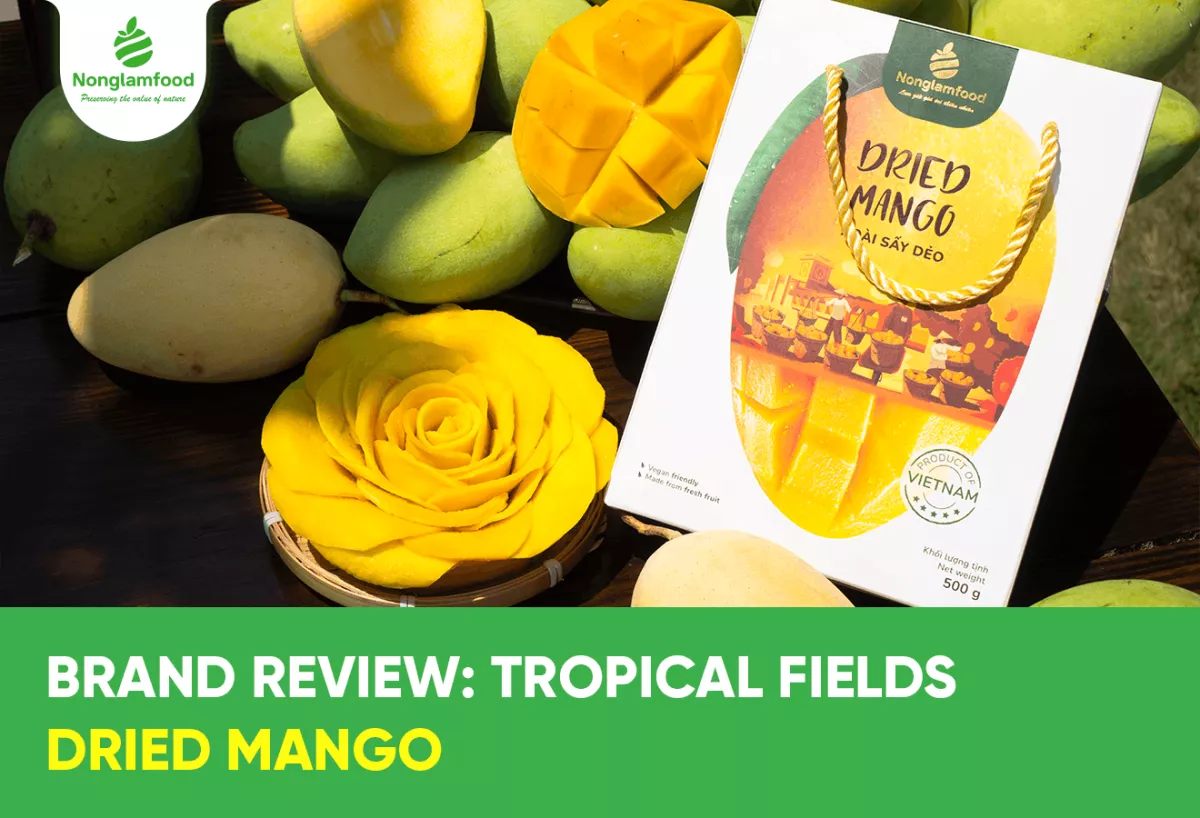
1. Tropical Fields Dried Mango: What It Is
Tropical Fields is a dried mango brand produced in the Philippines and distributed globally through warehouse retailers, most notably Costco. It is sold in large-format resealable pouches and positioned as a natural snacking product at a competitive price per gram. The product has built a substantial consumer following on the back of its consistent availability, soft texture, and accessible sweetness.
The ingredient list is straightforward: mango, sugar, and citric acid. It is a lightly sweetened product sugar is present as a processing aid that contributes to texture and shelf life, alongside the mango's own naturally concentrated sugars. The bright yellow-orange colour and pliable texture are the product's most consistent characteristics across purchase occasions.
For consumers who want a widely available, affordably priced, consistently soft dried mango for everyday snacking, Tropical Fields fulfils that role reliably. Where the product sits in relation to the broader dried mango category and whether it is the right choice for your specific needs depends on the criteria you are evaluating against. That is what the rest of this guide covers.
2. Beyond the Brand: How to Evaluate Any Dried Mango Product
Tropical Fields is one of dozens of dried mango products available globally from supermarket own-labels and health food store specialty products to direct-from-manufacturer imports and premium Vietnamese tropical fruit ranges. The challenge for any consumer or buyer is that most dried mango products look broadly similar on the shelf. The differences that actually matter are not visible from the outside.
Rather than comparing brands directly, the more useful exercise is understanding the five criteria that determine dried mango quality across the category and applying them to any product you are evaluating, including Tropical Fields. These criteria are grounded in food science and nutrition research, not marketing positioning.
3. Criterion 1: Colour - The Most Accessible Quality Signal
The colour of dried mango is the first and most immediately available quality indicator. Genuinely premium dried mango has a deep, natural amber-golden tone the colour of ripe mango flesh, concentrated by careful low-temperature drying. This colour reflects intact beta-carotene and carotenoid pigments that are heat-sensitive and degrade progressively at drying temperatures above 60°C.
Pale beige or light yellow dried mango has typically been processed at higher sustained temperatures, causing significant carotenoid loss alongside Vitamin C and polyphenol degradation. Bright, vivid yellow-orange can indicate colour maintenance through citric acid treatment or sulphite use which stabilises appearance without necessarily preserving the underlying nutrient compounds.
As a general rule: deep amber-golden colour is the signal of carotenoid preservation and careful low-temperature processing. It is the colour to look for when prioritising nutritional quality over visual uniformity.
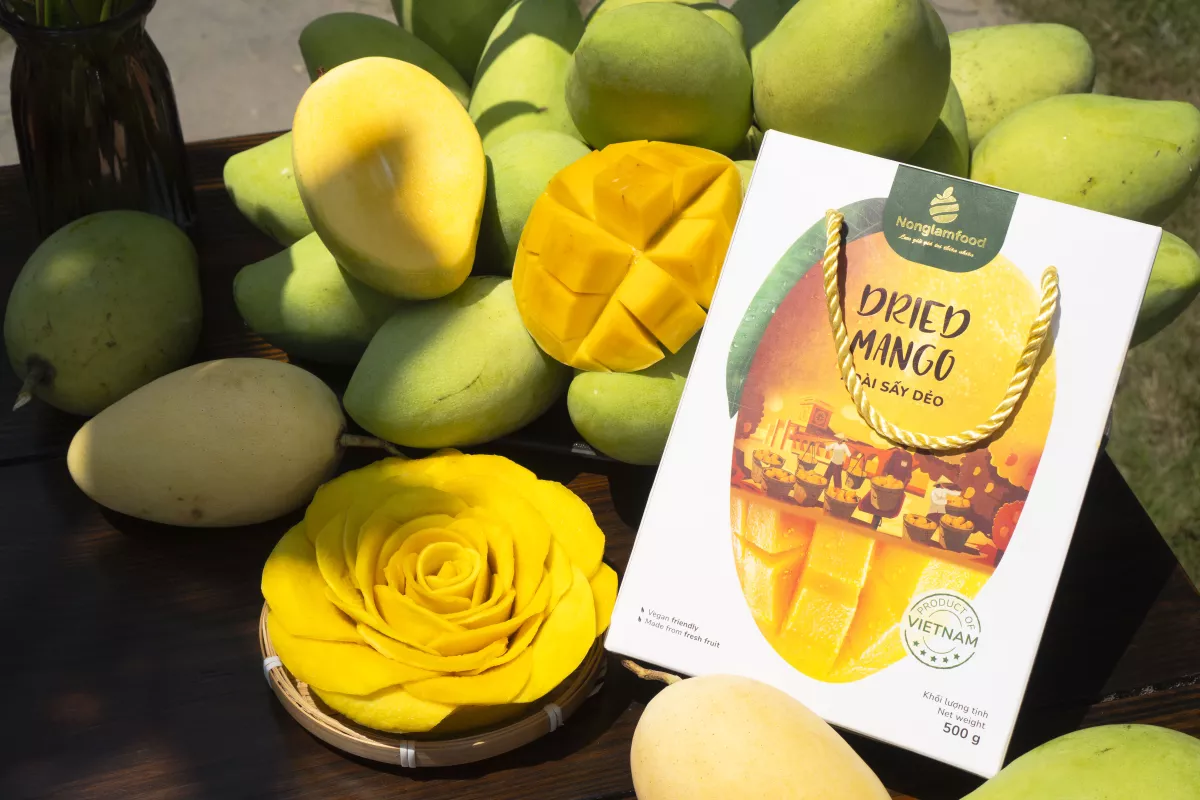
Crafted from hand-selected Vietnamese mangoes by a food science team with expertise from Nong Lam University and Ghent University
4. Criterion 2: Ingredients and Added Sugar - Reading the Label Carefully
Ingredient lists in food products are required to list components in descending order by weight. For dried mango, the ideal short-form ingredient list is: mango, and optionally ascorbic acid (Vitamin C, used to prevent surface browning). When sugar or glucose syrup appears as the second ingredient, it indicates a meaningful added sweetener quantity on top of the fruit's own naturally concentrated sugars.
According to USDA FoodData Central, a standard 40g serving of no-added-sugar dried mango already contains approximately 27g of natural sugars from the drying concentration effect the fruit's own sweetness is already significant. The added sugar line on the nutrition panel (now required on EU and US labels separately from total sugars) is the specific number that reveals how much sweetness has been added beyond what the fruit provides.
| Added Sugar per 100g | Category | What It Signals |
|---|---|---|
| 0g | No added sugar | All sweetness from the fruit. Best for health-focused consumers. |
| 1 - 5g | Minimal | Small addition for texture or shelf life. Nutritionally close to no-added-sugar. |
| 6 - 15g | Lightly sweetened | Product tastes noticeably sweeter than the fruit alone. Profile is sweetness-forward. |
| 16 - 25g | Moderately sweetened | Sugar is a meaningful ingredient. Product is closer to confectionery than natural dried fruit. |
| 25g+ | Heavily sweetened | Likely compensating for flavour loss from high-temperature processing. |
Reference: USDA FoodData Central. Natural sugar in no-added-sugar dried mango: approximately 65 - 70g per 100g, all from the fruit.
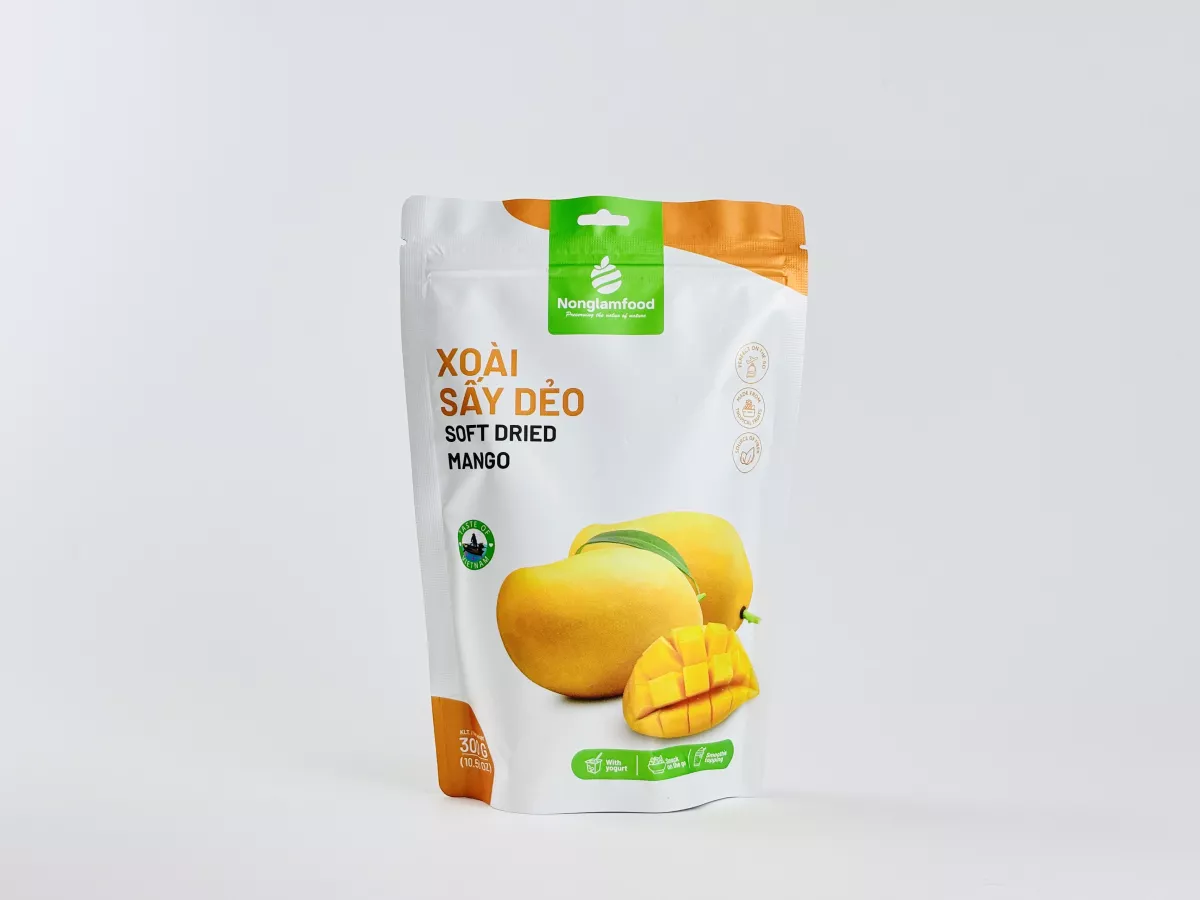
Nonglamfood Soft Dried Mango reflects a production process where quality is measured, not assumed
5. Criterion 3: Drying Method - The Variable That Determines Nutritional Value
The drying method is the most important production decision affecting dried mango quality and the one least likely to appear on retail packaging. Understanding the difference between conventional and premium drying approaches helps explain why two products made from identical raw material can deliver dramatically different results in colour, aroma, and nutritional content.
a. Conventional Hot-Air Drying (65 - 80°C Throughout)
The most widely used commercial method. Hot air circulates through the drying chamber at 65 - 80°C from start to finish. Effective for moisture removal, but sustained high temperatures cause measurable Vitamin C losses (20 - 50% documented in food science literature) and drive off the volatile aromatic compounds responsible for fresh mango's characteristic fragrance. Products from this process tend to require more added sugar to achieve good flavour, and tend toward paler colour.
b. Heat Pump Two-Stage Drying (Stage 1: 60 - 65°C -> Stage 2: 25 - 30°C)
A more advanced approach that protects heat-sensitive nutrients during the critical final drying phase. Stage 1 removes free water efficiently at 60 - 65°C with limited heat damage because the endothermic nature of evaporation keeps product temperature below air temperature. Stage 2 drops to 25 - 30°C using a refrigeration condensing unit, removing remaining bound moisture without the thermal damage that conventional Stage 2 temperatures cause.
From Nong Lam Food's food science team: “The Stage 2 temperature is where the quality difference is made. At 25 - 30°C, the Vitamin C, polyphenols, natural colour pigments, and volatile aromatic compounds are all protected from the heat damage that conventional drying causes at this critical phase. The deep amber-golden colour and strong mango fragrance of our product on opening are the direct, visible results of that temperature discipline not marketing language."
c. What to Ask Any Dried Mango Supplier
If you are evaluating a product for regular consumption or sourcing purposes, one question cuts through the marketing quickly: what temperature does your Stage 2 drying operate at? A producer using genuine heat pump drying will give a specific answer (25 - 30°C). A producer using conventional drying may not have a clear answer, or will quote only their Stage 1 temperature. The ability to answer this question specifically is itself a quality signal.
6. Criterion 4: Origin - Why Raw Material Quality Sets the Ceiling
The quality of the finished dried mango product is bounded by the quality of the raw material. No amount of careful processing can fully compensate for mango harvested under-ripe, from varieties with lower Brix, or from growing conditions that produce lower flavour intensity.
Vietnam's Mekong Delta has emerged as one of the world's most respected sources of premium dried mango raw material. The region produces mango varieties including Cát Chu and GL3 with naturally high Brix levels of 16 - 20°Bx at harvest levels that provide substantial natural sweetness without requiring significant sugar addition during processing. The extended harvest calendar (main season March to June, off-season October to January through managed flowering) enables year-round sourcing of consistently ripe raw material.
Origin does not automatically determine quality processing decisions made after harvest are equally important. But starting with high-Brix, low-fibre mango varieties grown in appropriate conditions gives premium Vietnamese producers a raw material advantage that lower-Brix origins cannot fully overcome through processing alone.
7. Applying the Framework: A Quick Evaluation Checklist
Use this checklist when evaluating any dried mango product including Tropical Fields, or any other brand you encounter:
| Check | What to Look For | Signal |
|---|---|---|
| Open the packet and smell | Strong, immediately recognisable fresh mango fragrance | Volatile aromatics preserved good sign for overall quality |
| Examine the colour | Deep amber-golden rather than pale beige or vivid uniform yellow | Carotenoids preserved heat damage limited |
| Read the ingredient list | Mango as first ingredient; no glucose syrup or sucrose in position 2 | Product is fruit-led, not sweetener-compensated |
| Check added sugars line | 0 - 5g per 100g on the nutrition panel | Minimal compensatory sweetening needed |
| Ask about drying method | Producer can specify Stage 2 temperature at or below 35°C | Heat pump or equivalent low-temperature processing confirmed |
| Check origin and certifications | HACCP / ISO 22000 minimum; BRC or FDA for EU/US retail | Production quality and food safety verifiable |
8. Conclusion
Tropical Fields dried mango is a familiar, accessible product with a loyal consumer base and for the market it serves, it delivers consistently. For consumers whose primary criteria are availability, consistent texture, and competitive pricing in a large-format pack, it is a reasonable choice.
For consumers and buyers whose priorities extend to nutritional quality, natural flavour intensity, minimal sugar addition, and production transparency, the criteria in this guide point toward a different tier of product one where the drying temperature, raw material Brix level, and added sugar discipline are the defining variables rather than packaging format and shelf presence.
The framework above applies to any dried mango product you evaluate. The best buying decision is not based on brand recognition or shelf position it is based on colour, aroma, ingredient list, added sugar level, and a producer who can answer direct questions about their process. Those five things tell you more than any label ever will.
Nong Lam Food's dried mango deep amber-golden colour, limited sugar addition, heat pump Stage 2 drying at 25 - 30°C, and full technical documentation available on request. Apply the checklist above and see for yourself: request samples at vietnamdriedfruits.vn.
Related information
- Top Health Benefits of Eating Dried Mango
- Does Dried Mango Make You Poop? Digestion Explained
- What Happens When Eating Dried Mango Everyday?
- Vietnam Queen Pineapple – A Gift From the Mekong River Delta
- Dried Mango Potassium Content: How Much and Why It Matters
- Natural dried mango manufacturer|supplier for import|export
PRODUCT CATEGORIES
NEWS

Partner with us to provide and elevate healthier food options while supporting sustainable agriculture with a passion to serve and a commitment to innovation. Together, we can improve the lives of disadvantaged farmers and generate a positive impact!

